|
A mix of culture, past and present, makes Saratoga County the most unique and popular county in upstate New York.
The fruitful hunting ground of the Iroquois was called Sarachtogue, "hillside of a great river,"
"place of the swift water," until 1791 when the area became Saratoga County.
Because of its favorable position in the angle of the Hudson and Mohawk Rivers, Native American
Indian trails crossed the County in all directions. Early fur trading on the southern border of the
county was indicative of its fur and game potential. The mineral springs were used as medicine by the
Indians and the superior quality of the fur was attributed to the saline springs from which the animals drank.
After the American Revolution, colonization began to accelerate, and the great forest then covering
a large part of Saratoga County was cleared and lumbered for timber. The lumber and by-products were
carried by many streams to the Hudson River and distant markets. Because of the density of the forest,
the pine trees grew tall and straight and were in great demand for ship masts.
Clearing of the land led to the establishment of mills. The tanning industry and other types of mills
developed as use was made of the abundant water power within the County.
The mineral springs in Ballston Spa and Saratoga Springs became the lodestar for fashionable society;
the two villages vied for the title of "Queen of the Spas."
Famous names from all over the United States such as Daniel Webster, Martin Van Buren, Washington Irving,
Andrew Jackson and Franklin Pierce were found on hotel registers. Life was fast and money even more so.
The Spas' fame continued to rise to international acclaim. The Vanderbilt's, Whitney's, Rockefeller's,
J.P Morgan, "Diamond Jim" Brady, Lillian Russell and others added glamour to the County. With the influx
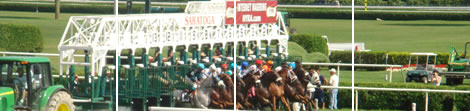
of the social elite and the wealthy, horse racing was the natural development; it flourished until the
name Saratoga became internationally synonymous with racing.
1910 brought three years of despair with the prohibition of gambling. Along with the 1920's came a
resurgence slightly tinged with a more exuberant and flamboyant style. Survivors of the Depression
maintained the grandeur and energy until the 1930's when natives began to complain about the influx
of gamblers, gangsters, bookies, pimps and prostitutes. Life in Saratoga began to ebb. The years during
WWII brought with them the stark realization that a glorious century had ended. Racing was suspended for
three years, and great hotels suffered and declined. It seemed that the celebrated past had been neatly swept
into Edna Ferber's famed novel Saratoga Trunk to preserve an era.
Today, Saratoga once again stands proud and prosperous. A revitalization of the past combined with new
investment of the present by community leaders, banks, citizens and organizations has made Saratoga
County a center of culture, education, and clean industry.
Saratoga enjoys a keen business climate induced by tax incentives, an abundant skilled labor force,
and other locational qualities.
Skidmore College and other educational institutions have enriched the academic environment of the area.
The Saratoga Performing Arts Center, opened in 1966, is the summer home of the Philadelphia Orchestra, the
NYC Ballet, the NYC Opera, and top performers of jazz, pop and rock music.
The countryside's historic aura is accentuated not only by the Victorian homes that flourish in Ballston
Spa, Round Lake, Stillwater and Saratoga Springs, and the remembrance of the Battle of Saratoga which marked
the turning point of the American Revolution, but also by the National Museums of Racing, Dance, and the National
Bottle Museum. From the well-preserved Saratoga Race Track, and the beautiful Harness Track, to the mineral springs
on the 2,100 acre Spa Park, residents and visitors alike can rediscover the treasures of Saratoga.
No matter how rich Saratoga's history, it's most valuable asset is the people who live here. Their concern for
the community has stimulated the continual growth and restoration of its villages and towns. Many channels have
been created, in the form of associations and organizations, which are constantly striving towards a greater awareness and satisfaction.
Selected Attractions
The Saratoga National Historical Park
Stillwater, NY 12170
518-664-9821 ext. 224 (information desk)
http://www.nps.gov/sara/index.htm
The Saratoga National Historical Park is comprised of three sites. The largest is the
Saratoga Battlefield, considered the turning point of the Revolutionary War, and is located
on the Hudson River about fourteen miles east of the City of Saratoga Springs. Eight miles
north are the Schuyler House in Schuylerville and the 155 foot tall Saratoga Monument commemorating
General Burgoyne's surrender to General Gates in the town of Victory.
Here in the autumn of 1777 American forces met, defeated and forced a major British army to surrender.
This crucial American victory renewed patriots' hopes for independence, secured essential foreign
recognition and support, and forever changed the face of the world.
| |



 health